Japan AI Policy 2026: Promotion Law, Data Consent Reform, and the NICT Safety Platform
EU tightens the screws while Japan bets on soft law and innovation-first governance — four shifts enterprises need to track
As of May 2026, Japan’s approach to AI regulation remains firmly “promotion-first, light-touch” — yet three concrete policy tracks are now advancing in parallel: personal data consent reform, the NICT safety evaluation platform, and the Cabinet Office’s Principle Code. All three move while the EU AI Act enters full enforcement mode.
This trajectory reflects Japan’s AI Governance philosophy and its broader Sovereign AI bet: nurture a competitive domestic AI industry while staying loosely aligned with G7 norms through the Hiroshima AI Process.
The AI Promotion Law: What “Soft Law” Actually Means
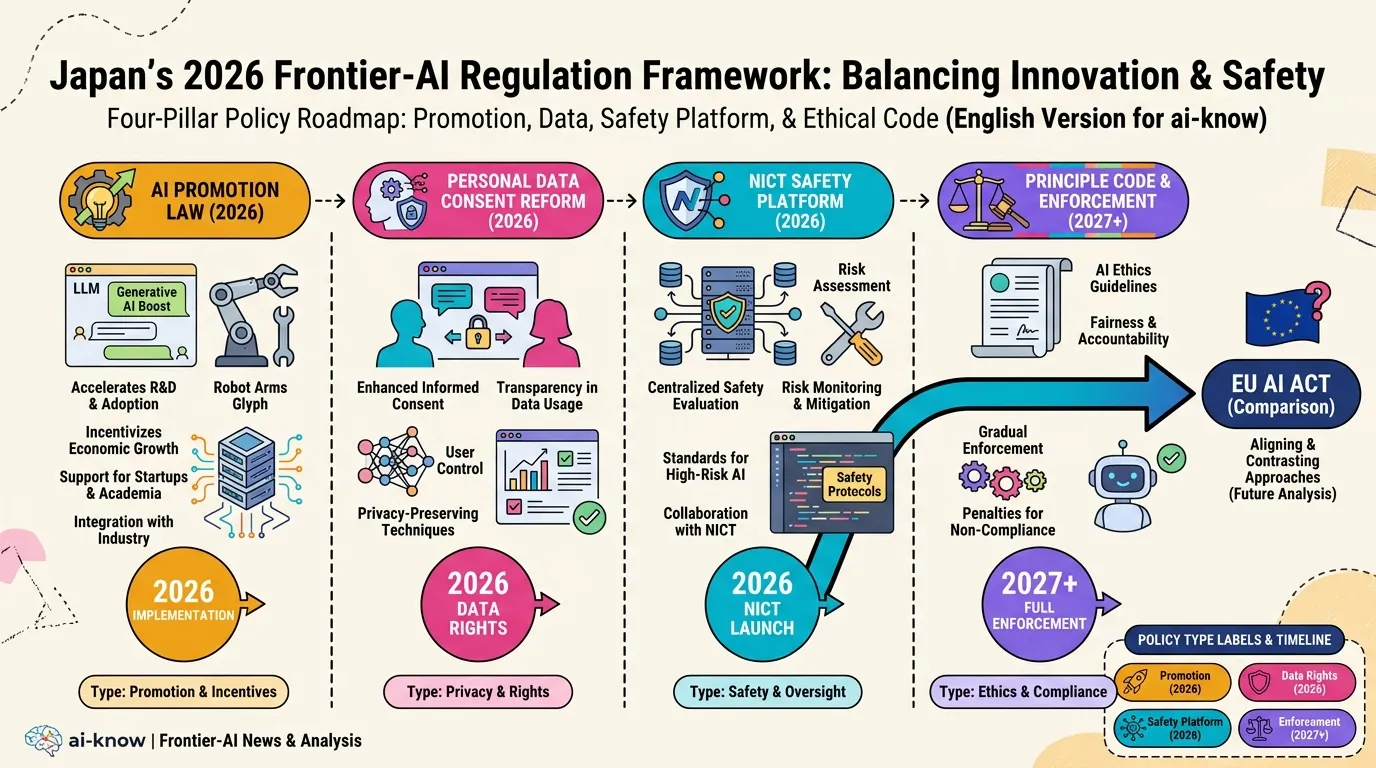
Japan’s AI Promotion Law (Act on Promotion of Research, Development, and Utilization of AI-Related Technologies) entered full force in September 2025. Its defining characteristic — in contrast to the EU AI Act — is that innovation promotion is the primary objective, not risk mitigation.
Mandatory requirements for high-risk AI systems are deliberately limited. Most compliance expectations are framed as “best effort” obligations or voluntary guidelines. Critics call this a regulatory gap. Proponents argue it protects the space needed for rapid experimentation and domestic AI industry growth. Both are partly right.
When Personal Data Consent Exemption Becomes Real
In January 2026, Japan’s Personal Information Protection Commission announced it was exploring an exemption to third-party data sharing consent requirements — specifically for AI training purposes.
If enacted, this would materially lower the data acquisition cost for domestic AI companies. Across financial services, healthcare, and retail, obtaining individual consent has been the biggest bottleneck in building high-quality training datasets. The tradeoff is real: privacy rights remain in tension with this proposal, and the final decision will require political negotiation. Until the exemption is formally adopted, large-scale early commitments carry legal uncertainty.
NICT Safety Platform and the Principle Code
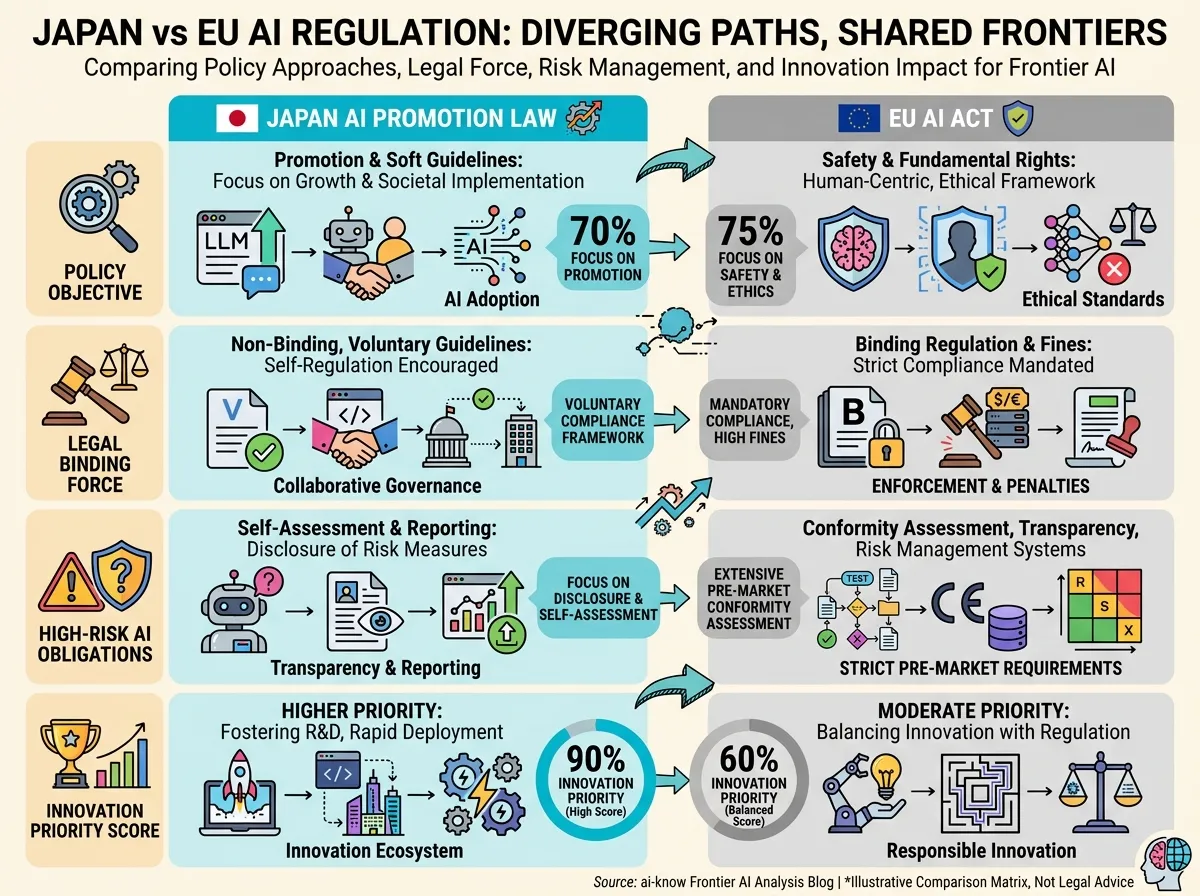
NICT (National Institute of Information and Communications Technology) launched a dedicated AI reliability and safety evaluation system in 2026 — positioning the government as a credible third-party certifier for generative AI systems. If government procurement requirements begin referencing NICT certification, it could become a de facto entry requirement for public-sector AI contracts.
The Principle Code (draft), published by the Cabinet Office in December 2025, sets out behavioral guidelines for AI developers and providers covering transparency, copyright protection, and bias management. It carries no legal force, but expect it to be referenced in procurement tenders and enterprise contracts involving EU or U.S. partners.
International Alignment and Enterprise Impact
“Japan’s soft-law path gives enterprises near-term flexibility — but the pressure for harmonization with EU and U.S. standards will only increase.”
Japan’s participation in the G7 Hiroshima AI Process and OECD AI Principles provides a framework for international alignment, but mutual recognition of safety evaluation standards with the EU and U.S. remains unresolved. Companies operating globally may face the cost of dual compliance if that gap persists.
What enterprises should prepare for now:
- Personal data consent exemption → a material opportunity if enacted; hold off on large-scale legal restructuring until the final ruling
- NICT safety platform → treat third-party certification as a likely requirement for government and quasi-public sector contracts
- Principle Code → build an internal roadmap now, since EU and global partners may reference it in contract negotiations
Sources: 【2026年最新】生成AIの規制動向を解説!日本と海外の法律や企業の対策 — AX Media, 2026
Related Articles
10 Charts That Explain AI in 2026: Progress, Adoption Gaps, and Backlash
ServiceNow's AI Control Tower: Agentic AI Governance from Desktops to Data Centers
Anthropic Launches Claude for Small Business: 15 Agentic Workflows to Close the SMB AI Gap
Sierra's $950M Raise Signals the Enterprise AI Consolidation War
Anthropic Launches "Code w/ Claude 2026" — The Next Chapter of Agentic Coding Begins in SF